

Most VC-backed founders inherit a board before they understand one. Here’s how to lead yours — from first seat to full governance maturity.
Key takeaways
- A board of directors is a company’s legal governing body, and board governance is the system by which that body operates, encompassing the structures, policies, and practices that will determine whether the board will be a strategic asset or a liability.
- Board composition should be planned by company stage rather than funding round, evolving from a three-person seed board to five seats at growth and seven with an independent majority at maturity.
- Most boards add their first independent director around Series A, when institutional investors arrive, governance is formalized, and decisions begin having longer-term consequences.
- Observer rights grant contractual access to board meetings without a vote or fiduciary duty, and companies should manage observer lists actively, as observers often have access to confidential materials.
- Directors’ fiduciary obligations including owing duties of care and loyalty to the company, not to any investor or their own shareholder interests, a distinction codified under the Canada Business Corporations Act that founder-directors should understand.
A board of directors can be one of the most consequential factors in a company’s success. When working well, a board provides strategic insight, credibility, and experience that many founding teams need, as well as accountability if things go off track. However, when structured poorly, a board can create friction when alignment matters most.
Canadian VC fundraising fell to just $2 billion in 2025, a fraction of the $7+ billion peak in 2021-2022. The top five funds captured 83% of all capital raised. When money is that scarce and concentrated, governance is part of what gets you funded. In this guide, we’ll explore the role and functions of a board of directors throughout the early, growth, and maturity stages of venture capital (VC)-backed startups, as well as some best practices in board governance and the most common governance mistakes founders make — and how to avoid them.
What is a board of directors and what does it do?
A board of directors is the group of individuals elected or appointed to collectively govern and provide oversight for a company. It holds ultimate legal and fiduciary responsibility for the organization on behalf of its shareholders and stakeholders, and the decisions it makes or ratifies carry legal weight. It’s neither an advisory group nor a management team, but rather the company’s supreme governing body.
The board sets and oversees strategic direction, manages and evaluates senior leadership, authorizes major financial decisions, and makes the highest-stakes decisions a company faces: hiring (and, if necessary, firing) the chief executive officer (CEO), approving strategic pivots, authorizing new financing rounds, and overseeing mergers and acquisitions. It governs at a high level, leaving day-to-day operations to the founders and executive team.
For public companies, shareholders elect directors at annual general meetings. In private VC-backed startups, board composition is typically determined by the company’s shareholder and investor rights agreements, which are usually revised at funding rounds.
Board governance is the system of practices, policies, and accountabilities by which the board operates — how it’s structured, how meetings are run, how information flows between management and directors, how decisions are documented, and how conflicts are managed. It’s the main determinant of whether a board will be a company’s strategic asset or a structural liability.
What are the various roles of board members?
A board is typically made up of inside and outside directors. Inside directors are usually company employees (or major shareholders); outside, or independent, directors are involved only through their board membership. Because independents face fewer conflicts of interest, they bring different perspectives and expertise.
A board typically includes the company’s CEO (often also the chairperson) and other senior officers. Directors may have specific roles:
- Chairperson: sets agendas, runs meetings, establishes committees, and may represent the company publicly.
- Vice chair: supports the chair, helps manage conflicts of interest, and steps in when the chair is unavailable.
- Secretary: manages administrative tasks, such as meeting minutes and corporate records.
- Treasurer: oversees budget, financial policies, accounting, and investments.
The board can also include specially appointed advisors (see “Board of directors vs. advisory board vs. startup advisor”).
How are board members selected?
Patrick Searle, chief executive officer of the Council of Canadian Innovators (CCI), works with some of Canada’s most successful technology founders with programs such as the Innovation Governance Program (iGP). He’s seen firsthand how important it is to find the right individuals when formalizing a board structure.
“We ask our CEOs a pretty simple question: what does your company need to win over the next three to five years?
“If you’re going global, find somebody who has gone global. If the value of your company is overwhelmingly in IP and data, you’d better have people around the table who understand IP and data. If you’re going to need enormous amounts of capital, get people who understand capitalization.
“In many cases, the number of directors a founder can personally choose shrinks over time as investors take seats around the table. That makes those choices even more important.”
“We ask our CEOs a pretty simple question: what does your company need to win over the next three to five years?”
In early-stage companies, recruitment and selection rarely follows a formal process. A VC may negotiate a board seat as part of a funding round. Independent directors are often sourced from a founder’s personal network or investor introductions, chosen for specific expertise or relationships. Once a candidate is agreed upon, the board votes to approve them and documents the decision in its board resolutions and corporate records.
How are board members removed?
Voluntary resignation is the most common way a board member exits. Removal can also follow a formal shareholder vote, most often in VC-backed companies, where investor agreements grant specific shareholder classes the right to recall and replace a director they’ve appointed. In practice, most departures are negotiated privately, and the legal mechanisms exist mainly as a backstop when those conversations break down.
Does a board of directors get paid?
Compensation varies by stage, but norms are consistent across the Canadian and U.S. startup ecosystems.
At the early stage, investor and founder directors usually receive no separate board compensation — their returns come from their investment or founding equity. Independent directors are typically compensated with equity grants (usually of 0.25%-0.5%) at Series A, and somewhat higher (often 0.5%-1.0%) at seed, subject to a two- to four-year vesting schedule with a one-year cliff. Cash retainers are uncommon at seed or Series A, when conserving cash is the priority; equity remains the dominant form of independent-director compensation through the early stages.
At the growth stage, equity grants for independent directors range from 0.1% to 0.25%, reflecting higher valuations and tighter dilution budgets. Cash retainers usually begin at Series B and beyond, particularly for directors contributing significant time to committee work or special projects.
At the maturity stage, as the company approaches pre-IPO readiness, independent director compensation increasingly resembles public company norms, with annual equity grants of defined size plus cash retainers and committee fees where applicable.
Advisory board members are typically compensated with smaller equity grants of 0.1% to 0.25%, often structured using an Advisor Standard Agreement (FAST) template from the Founder Institute or a similar framework.
Why does board governance matter for VC-backed startups?
For VC-backed startups, solid board governance is especially crucial in the early stages, when the stakes are high and the margin for error is narrow. Founders are often first-time directors, and the company is making consequential decisions on hiring, capital allocation, and strategy at a quick pace, leaving little room for governance dysfunction.
”The minute you take a dollar of somebody else’s money […] the person who gave you that money deserves to know that it’s being spent and managed in a professional manner, and a board makes you do that.”
Matt Roberts, RBCx’s Managing Director, VC Coverage, has seen the value a board can bring. Moving to a board can be a jarring transition for some founders, but it’s a necessary step in a company’s evolution.
“CEOs feel like this is their company, and they’re still running it the way they were before they had investors. That argument goes right out the window the moment you take a dollar of somebody else’s money. The person who gave you that money deserves to know that it’s being spent and managed in a professional manner, and a board makes you do that.
“People are going to disagree with you. That’s the fiduciary obligation of the board. It’s not to tell you how to run a company. It’s to question your decision-making and make you rationalize what you’re doing.”
Searle agrees that a founder’s temperament matters when working with a board. “No CEO is 10 out of 10 at everything. A good board asks: how do we augment this CEO so they can spend more time doing what makes them exceptional, while helping them develop where they need to get better?”
A well-governed company is simply easier to diligence, finance, and acquire. Governance also creates fiduciary accountability: directors of VC-backed startups owe duties to the corporation and its shareholders regardless of a company’s internal circumstances (see “Fiduciary duties for founders”). Investors have reporting obligations to existing VCs, future investors, and, in some structures, limited partners, making governance a contractual requirement as well as a legal one.
Board of directors vs. advisory board vs. startup advisor
The advisory board, startup advisor, and board member roles share traits, but the legal and governance implications differ materially. A board of directors has voting rights, holds fiduciary duties, is bound by confidentiality and conflict-of-interest obligations, and is typically compensated with equity early on. Directors attend meetings, review materials, and exercise careful oversight. Their decisions are documented and can be legally consequential.
An advisory board member has no legal standing, no fiduciary duty, and no vote. Their role is to provide guidance, introductions, and expertise; they aren’t accountable to shareholders and can’t be held liable for company decisions. They’re compensated with small equity grants and the relationship is only lightly structured. Advisory boards are most useful for early-stage companies that want domain expertise or network access but aren’t ready for formal board governance.
A startup advisor is engaged for specific expertise (e.g., go-to-market strategy, technical architecture, a particular market vertical) and compensated with a small equity grant or an advisory fee. Unlike advisory board members, advisors have a defined, limited scope, no governance role, and no access to confidential board materials unless separately disclosed.
The key distinction is accountability: a board director is accountable to the corporation and its shareholders, but an advisor isn’t accountable to any particular entity.
As Searle notes, advisors can be a strong strategic asset: “Sometimes you need somebody’s brain without needing them on your board. An advisor can give a founder access to very specific expertise, experience, or networks without occupying a board seat that the company may need for something else as it grows.”
Many boards also use a governance committee, a formal subcommittee, typically composed of board members, investors, and (sometimes) independent advisors, that ensures the board itself is structured and operating effectively. Governance committees are most common at the maturity stage, but treating governance as a distinct function can contribute to a company’s progress from the earliest stages.
When should a startup form a board of directors?
Board composition is one of the most consequential governance decisions a founder can make, and its importance grows over time. Technically, a company has a board from the moment it’s legally formed, usually just the founder(s). The real question is when to bring in outside directors and treat the board as a genuine governance body.
“Often, one of the things that accelerates the formation of a board is a company’s pursuit of growth capital,” Searle says. “Different investors, at different stages, will have different expectations of a company’s governance. You don’t want the first time you’re seriously thinking about your board to be when an investor asks you who’s going to sit on it. Know what the next stage of the company is going to demand, what skills you’ll need around the table, and start building those relationships before the need becomes urgent.”
For Roberts, the earlier a company can form a board, the better. “It brings a level of decorum and responsibility into the founding team’s mentality. The moment you take a dollar from somewhere outside of your founding team, that’s the moment you should start thinking about having a proper board composition built.”
Planning board composition is best strategized by stage, not funding round. A stage framework maps a board’s evolution to the governance challenges the company’s actually facing, rather than capital market benchmarks that change with the environment. The directors appointed at the earliest stages will set the precedent for a company’s governance culture; the independents added as it grows will shape the board’s ability to function effectively at maturity and as it progresses through Series A and B.
“A healthier, stronger board generally leads to easier outcomes on the fundraising process,” Roberts says. “A board doesn’t necessarily fix the fundamental issues of the company. If the product just doesn’t fit the market, you can’t fix that — that’s always on the founder. But it gives the next level of institutional players a level of comfort and a feeling that: I can work with this person, because look what the board is doing.
“You’re building a credibility layer [that] shows a level of coachability and maturity, and that gives comfort to bigger cheque sizes from larger institutional players.”
How to build a startup board: Board composition at each stage
Early stage
In the early stages, founders are typically a company’s sole directors. Formalizing the board typically starts with a company’s first institutional investment, as a VC fund will almost always negotiate a board seat as part of the deal. The most common seed structure is a three-person board: two founders plus one investor director, letting the founder(s) retain a voting majority while adding a valuable outside perspective.
Growth stage
At the growth stage, the board might expand to three to five seats (odd numbers prevent voting stalemates), driven by new investor rounds and a company’s growing need for diverse expertise. This is often when an independent director first becomes valuable, providing objectivity when difficult decisions arise around issues such as CEO transitions, acquisitions, or founder-investor conflicts. Founders should negotiate board seat triggers and observer rights carefully at every round, since the board they agree to at Series A will be the company’s foundation all the way to exit.
Maturity stage
At maturity, the board begins functioning as a genuine institutional governing body, typically with seven seats. Board committees overseeing audit, compensation, and governance start to become necessary. An independent director, Roberts says, should be “a third party, somebody who either knows the space, knows the technical challenges the company’s going to have, knows the business market, or who has some sort of understanding that the board might not have. You’re looking for somebody whose reputation is more important to them than placating a bunch of VCs at the board.”
How many board members should a startup have?
The optimal size for a board will depend on a company’s specific needs, but in general it’s advisable to start small, grow purposefully, and always keep an odd number to avoid deadlocks.
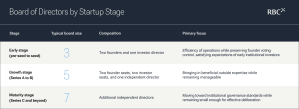
The table above summarizes typical sizes and compositions at each stage of a board’s evolution. The key principle is that adding more than seven seats risks making the board too large for effective deliberation.
Investor directors vs. independent directors
The investor director and independent director roles might sound similar, but they have their own incentive structures and obligations, and provide different value to the company at different stages.
Investor directors
An investor director is appointed by a VC fund, typically as a condition of the fund’s investment. They represent the fund’s interests by relaying information and advocating for decisions that protect and maximize its return. They hold information rights by investment agreement, can vote, and bring the fund’s network and pattern recognition to the board.
Investor directors aren’t neutral parties — they’re incentivized by their fund’s return profile. Their interests and the company’s are most often aligned, but any divergence can become real and consequential. Ultimately, a VC’s input is meant to be limited to budgetary concerns, not questions of a company’s direction or culture. As Roberts says, “Budget is the only thing you have control over as a VC. Generally speaking, the CEO has to live or die within that budget. But that’s the only thing. Everything else is advice. Everything else is superfluous.”
Independent directors
An independent director has no financial stake in the company prior to their appointment, outside of the equity compensation they receive for board service. They’re recruited for their expertise, judgment, and objectivity. The best independents provide a perspective that isn’t influenced by cap table politics but oriented purely toward the company’s best interests.
Most boards add an independent director around Series A, when institutional investors arrive, governance formalizes, and board decisions start to carry material long-term consequences. A board with both investor directors and independent directors avoids being overly dominated by either founders’ preferences or economic expectations of investors.
European Corporate Governance Institute (ECGI) research on board dynamics across the startup life cycle finds that the typical board structure in the second and third financing rounds is two investors, two entrepreneurs, and one independent director in a tie-breaking role, reflecting the independent director’s function as a mediator when founder and investor interests diverge.
Observer rights: What they are and how to manage them
Observer rights are the contractual rights to attend board meetings without a vote. They’re common among VC-backed startups and more significant than many founders realize.
VCs negotiate for observer rights primarily for information access and relationship maintenance. For smaller investors who haven’t secured a board seat but want visibility into a company’s performance and strategy, observer rights are a lower-cost alternative to full board representation.
Observers have no vote and no fiduciary duty to the company. Since they aren’t legally board members, they don’t bear the liabilities that come with membership. They often have access to confidential board materials, including the same pre-reads, financial updates, and strategic documents as full directors, and can participate in most meetings.
However, the company usually retains the important right to withhold information from observers when necessary, to protect attorney-client privilege, prevent disclosure of trade secrets, or manage conflicts of interest. Companies should ensure any observer rights agreement explicitly preserves this ability. Because observers have crucial access to information and presence, even without a vote, founders should manage observer lists actively and be prepared to limit access as the board’s work becomes more sensitive.
Fiduciary duties for founders
Every founder who’s also a director of their company holds fiduciary duties to that company, and it’s important that they understand what those duties are and how they might conflict with one’s personal interests.
Under the Canada Business Corporations Act (CBCA) (or the parallel Ontario Business Corporations Act (OBCA) for Ontario-incorporated companies), directors owe two principal duties: a duty of care and a fiduciary duty of loyalty.
The duty of care is the obligation to make informed and competent decisions — attending board meetings, reading materials, and exercising the diligence necessary for significant decisions. A director who rubber-stamps management decisions without review, consistently misses meetings, or votes on matters they haven’t read is failing their duty of care.
The fiduciary duty of loyalty is the obligation to act in the best interests of the company and to manage conflicts of interest. When decisions are formed, the interests of the company take precedence, not those of the director or any individual shareholder, investor, or counterparty.
For founders of VC-backed startups, loyalty conflicts aren’t uncommon. Secondary sales (i.e., a founder wanting to sell shares before a liquidity event) can create a conflict between the founder’s personal liquidity and the company’s interest in preserving its shareholder base. In exits, an acquirer may offer terms that benefit the founding team but not common shareholders.
Founders must recognize that their fiduciary duty as a director is to the corporation, not to any particular investor or their own economic interests as shareholders. A founder-director who defers to investor pressure rather than acting in the company’s best interest is failing their legal obligation.
For Canadian founders, the CBCA explicitly provides that no contract, articles, by-laws, or resolution can relieve a director from these duties: “Every director and officer of a corporation […] shall (a) act honestly and in good faith with a view to the best interests of the corporation; and (b) exercise the care, diligence and skill that a reasonably prudent person would exercise in comparable circumstances.”
Best practices in board governance: Board meeting structure and cadence
The goal of a board meeting should be strategic discussion, with decisions and deliberations that benefit from the diversity of experience and perspective of a functioning board. A well-run board meeting follows a consistent sequence:
- Send the board package in advance. Also called a “board deck” or “pre-read,” this is the collection of materials leadership prepares for directors ahead of a meeting: a summary of the recent period, financial statements and management accounts, progress on key metrics, department updates, and any resolutions requiring approval. Circulate it 48 to 72 hours in advance so meeting time goes to discussion, not review.
- Open with the consent agenda. Quickly dispatch routine items, such as approval of prior minutes, option grants, and any administrative resolutions not requiring deliberation. If an item on the consent agenda generates discussion, note it and handle it separately.
- Cover standing items briskly. Address financial review, key metrics, hiring updates, and any highlighted risks. The goal is to surface questions and flag material concerns, not to present information already covered in the board package.
- Strategic discussion. Most of the meeting should go to topics that genuinely benefit from board-level input, e.g., major market decisions, capital allocation, or competitive threats. The founder, as chair and facilitator, should manage time conscientiously and encourage input from independent directors.
- Close with a directors-only session. End with a brief closed session among directors only, without management present, giving independents space to candidly assess company performance and leadership without the influence of the CEO or management team.
These meetings, Roberts acknowledges, can often be extensive and demanding, which is exactly why a defined structure matters.
“There are two aspects to a board meeting. There’s the financial fiduciary obligation, and then there’s the coaching and professional backgrounds that you’re bringing to the table to have a discussion.
“There’s a fiduciary obligation to review the financial data of the company and make sure the company will survive. That’s 35% of a board meeting. Tell me about the finances. Let’s go through them line-by-line. It’s grueling. But that’s the fiduciary and legal obligation.
“Management discussion and transparency on issues with the company, that’s actually held outside of what, legally speaking, is a board meeting — more as an ad hoc meeting after the fact. We might have it five seconds after we stop the fiduciary obligations.
“Then, with bigger companies, you could have committees afterwards. You have an audit committee, you have a comp [compensation] committee.
“That’s why these are three- or four-hour meetings. It’s not because we want them to be. But these are board meetings. They’re not supposed to be fun.”
How often should a startup board meet?
The right cadence at which board meetings are held depends primarily on the company’s current stage.
At the early stage, monthly or bi-monthly board meetings are appropriate. The company is moving quickly, decisions are frequent, and investor directors benefit from close visibility.
As the company reaches the growth stage, quarterly meetings become the norm, reflecting greater organizational maturity and the higher costs of convening a larger board.
At the maturity stage, quarterly board meetings are standard, supplemented by formal committee meetings between board sessions and as-needed special meetings for significant decisions that can’t wait for the regular cycle — such as an unexpected acquisition offer, a leadership change, or a significant governance matter.
Best practices in board governance: What to report to your board
Effective board reporting isn’t about providing mountains of detail. It’s about consistency, precision, and giving directors sufficient context to drive meaningful discussion. Investors should get enough information to maintain trust, freeing the board to focus on strategy.
Every board package should include updates on the company’s cash position and runway, progress against key operating metrics, important hiring/staffing updates, and flags on material risks or strategic developments. These items should appear consistently so directors can track trends across reporting periods.
Reporting evolves by stage. At the early stage, it’s informal and focused on product, team, and fundraising. At the growth stage, it expands to include detailed financial accounts, departmental metrics, competitive landscape updates, and significant governance matters. At the maturity stage, reporting follows formal governance schedules, with committees receiving separate management accounts and audit reports in addition to the main board package.
It’s wise to establish a board calendar with set meeting dates, committee schedules, and reporting deadlines. Consent resolutions can handle routine approvals that don’t require deliberation. Decisions should be recorded rigorously: board minutes are a legal record, and thorough documentation of major decisions will matter later at exit.
More mature boards maintain a skills matrix — a document tracking the collective expertise and gaps across the director slate — refreshed annually to guide recruitment. Board effectiveness should be evaluated annually as well: informally at the early stage, but through a structured review process at the growth and maturity stages.
Reporting is one of the most important ways founders and boards interact. Managing that relationship can be difficult, but it’s critical to a company’s progress. The passion and qualities that make for a great founder, Roberts says, can make answering to a board difficult.
“You’re enabling people to have power over you. But that’s the sad reality of it. The minute you take outside capital is the minute you’re responsible to other people beyond just the founding team who’ve taken the risk at the very front end. You might not respect everyone on your board, but you have to respect what they’re representing.”
Common board governance mistakes — and how to avoid them
Many board governance failures stem from bad habits that form early and compound over time. Most, however, are avoidable. Here are some of the most common structural and behavioural mistakes founders make and what to do instead.
- Treating board meetings as investor updates. Put status updates in the pre-read and save the meeting agenda for substantive strategic discussion.
- Waiting too long to recruit an independent director. The earlier stages are often when an independent’s perspective is needed most. Start the search around Series A to be prepared when difficult decisions inevitably arise.
- Sending board materials the night before. Insufficient lead time leads to hasty, uninformed decisions. Circulate materials 48-72 hours in advance to set disciplined standards and encourage stronger strategic alignment.
- Not managing observer lists as the company scales. Establish a deliberate observer policy early, including limits on meeting attendance, to avoid disorganization and confidentiality breaches.
- Confusing fiduciary duty with loyalty to a VC. A founder-director’s fiduciary duty is to act in the company’s best interests. Consistently deferring to an investor director’s preferences fails that obligation.
- Under-reporting bad news. No board likes surprises. Surface and address all meaningful developments — even disappointing misses — in a timely fashion.
- Letting the board drift into operations rather than governance. Some investor directors are accustomed to hands-on involvement. Disciplined agenda management and ongoing stakeholder conversations help maintain boundaries between governance and management.
Beyond these guidelines, companies should always stay focused on their greater purpose and how boards can play an essential part in achieving it.
“The biggest mistake is forgetting what the board is there to do,” says Searle. “Governance can become an exercise in reports, committees and process, and all of that has a place, but the purpose of governance isn’t governance. The purpose is the success of the company.
“Building a company is bumpy. CEOs will make mistakes. Directors will disagree. When that happens, everybody around the table needs to remember: it’s not about me, it’s not about you, it’s about the company.”
”The purpose of governance isn’t governance. The purpose is the success of the company.”
Building a board that works: An advantage at every stage
Establishing a board of directors with an effective composition, consistent policies, transparent reporting, and directors who understand their distinct roles is challenging in a startup’s early days. But it pays off at every stage. A well-governed company raises its next round more efficiently, attracts better talent, and navigates difficult strategic moments with stronger decision-making infrastructure. Founders who treat their board as a strategic asset scale faster and achieve real, lasting success.
As Searle notes: “Increasingly, the assets that determine whether a company wins are intangible: IP, data, talent, know-how and networks. Those assets can be extraordinarily valuable, but they can also be transferred, constrained or captured in ways that traditional governance wasn’t built to recognize.
“That’s why directors have to keep learning. AI, cybersecurity, IP, data and geopolitics aren’t specialist topics anymore. They’re boardroom topics. The world our companies compete in is changing quickly and the people governing those companies have to keep up.”
RBCx works with founders across every stage of the startup journey, from seed-stage company formation to late-stage growth and exit. For more on building the governance infrastructure that scales with your company, explore RBCx’s venture banking resources and connect with the RBCx team.
FAQs
RELATED TOPICS
Other articles you may be interested in





 © 2026 RBC All rights reserved.