
Key takeaways
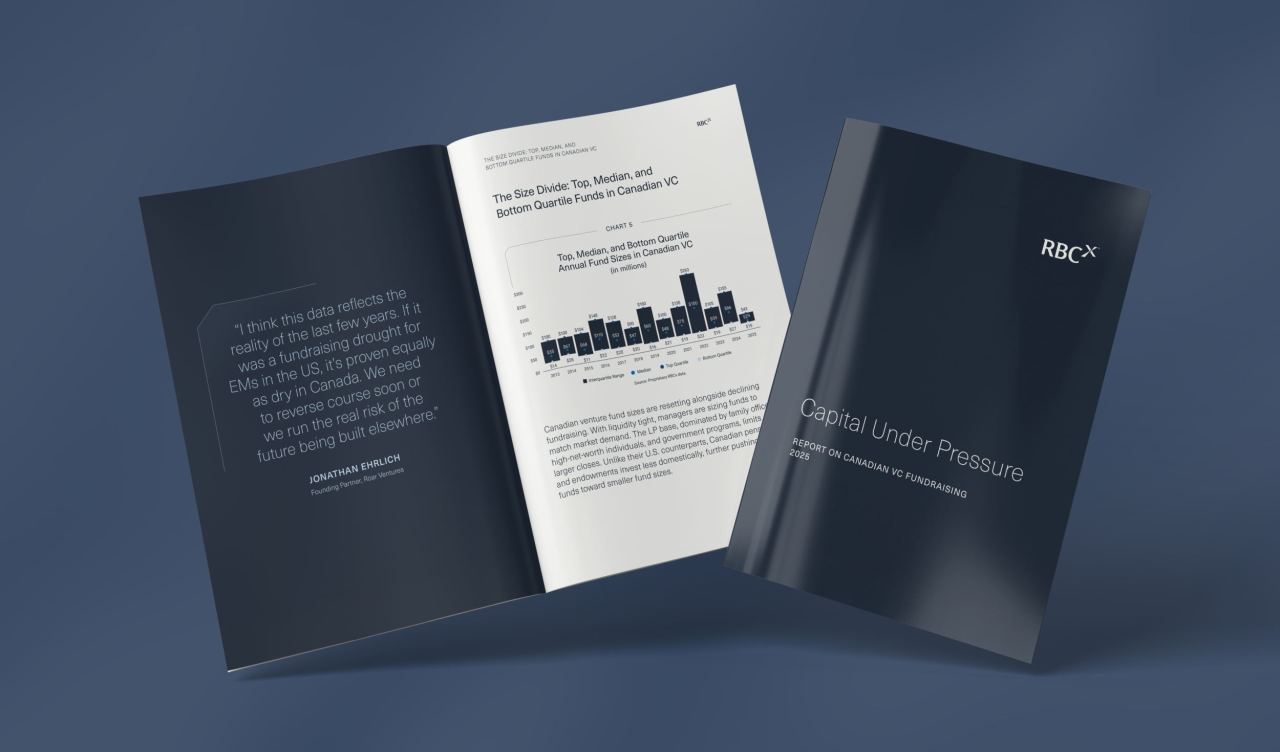
- Canadian VC fundraising hit just $2B in 2025 — far below the $7B+ peak of 2021–2022.
- The top five funds captured around 83% of all capital raised indicating a trend towards capital concentration.
- Emerging managers raised only $249M marking their lowest annual fundraising on record.
The signal most people miss and why it matters
Most venture coverage focuses on startup fundraising — the Series A, B, C, etc. rounds companies announce. But that’s the downstream story.
Venture fund fundraising is the leading indicator. The capital Limited Partners (LPs) commit today determines how much capital General Partners (GPs) can deploy into startups 12 to 24 months from now. When LP commitments shrink or concentrate, it’s often the earliest-stage companies that are most dependent on a diverse, risk-tolerant investor base that feel it first and hardest.
2025: A $2B year in a market that once raised $7B
Canadian VC firms raised just over $2B in 2025. At the last cycle’s peak, the market raised $7B in 2021 and $7.4B in 2022. Four forces drove the pullback: GPs still deploying 2021–2022 vintage capital, higher interest rates eroding venture’s illiquidity premium, public market corrections affecting LP valuations, and slower exits reducing cash available for reinvestment.
Capital concentration: 83% with five funds
In 2023, the top five Canadian VC funds captured 46% of total capital. By 2024, that was 67%. In 2025, it hit 83% — with Radical Ventures Fund IV, Portag3 Ventures Fund IV, Yaletown Growth Fund III, Version One Ventures Fund V, and Garage Capital Fund V representing most of the capital in market.
In dollar terms, the top five funds raised roughly half of what they did at the 2021 peak. All other funds combined dropped from $4.5 billion to $444 million over the same period — close to a 90% drop.
This concentration means fewer investment strategies, less diverse perspectives on what makes a fundable company, and a higher bar for founders trying to access a shrinking pool of decision-makers. A significant portion of this capital is also earmarked for deployment outside Canada, so headline fundraising numbers overstate what’s actually available to domestic startups.
The contrast with the US is instructive: 70% of US VC funding in 2025 went to companies raising $100M+, yet early-stage activity still grew modestly.
Emerging managers: A record low with real consequences
Emerging managers (EMs) raised $302M in 2025 — their lowest annual total on record.
“Every established firm in Canada, including Garage, began as an emerging manager — and only existed because LPs were willing to take earlier, riskier bets,” said Mike McCauley, General Partner, Garage Capital. “A healthy tech ecosystem depends on that same conviction today, giving new managers the runway to become tomorrow’s cornerstone franchises. EMs carry more risk, but they also inject new energy, push the industry forward, and can deliver some of the highest multiple returning funds. If this pipeline thins, we starve the very firms that will help shape Canada’s next decade of innovation.”
Without this cohort operating at capacity, founders face fewer genuine options, and the ecosystem loses the diversity of risk appetite that seeds the next generation of breakout companies.
What this means for founders
With less initial capital available, Canadian VCs will be more selective, rounds will take longer to form, and domestic capital available to new companies in Canada will be limited.
For now, the current composition of dry powder signals not only a smaller pool of domestic capital available for entrepreneurs, but equally, a clear constraint in Canada’s ability to invest in its own companies.
Practically, that means building VC relationships 6 to 12 months earlier than you think you need to, demonstrating capital efficiency, and widening your aperture to include non-dilutive funding, government programs, and international capital where relevant.
Looking ahead
Capital is scarce, concentrated, and selective — and the 2025 data sets the stage for 2026–2027. The questions that will shape the next cycle: whether LP appetite returns as interest rates shift and exits pick up; whether performance differentiation creates openings for smaller managers; and how government programs — including the CVCA’s proposed $750M federal envelope for early growth-stage funding — adapt to address the gaps private capital isn’t filling.
At RBCx, we remain committed to founders building through this environment. With tailored financial products, non-dilutive funding, and direct connections to VCs, our team is embedded in Canada’s innovation ecosystem at every stage, connected to the capital, communities, and conversations that help ambitious companies grow.
To see what’s changed in Canadian VC since this report, read our 2026 Market Check-In.
RELATED TOPICS
Other articles you may be interested in





 © 2026 RBC All rights reserved.