
Originally published October 23, 2023. Last updated September 20, 2026.
Key takeaways
- VC investors spend less than four minutes reviewing a pitch deck. Lead with your strongest content early.
- 10 to 15 slides is the funded sweet spot for a startup pitch (funded decks avg 11–13; unfunded 15–20+), and the traction slide appears in 92% of funded decks vs 57% unfunded. Make traction unmissable.
- Include a dedicated “Why now” slide, tailor your deck to your funding stage, and define your market with TAM, SAM, and SOM — all now standard in investor-ready pitch decks.
In the world of tech startups, securing funding is often the pivotal moment that can transform a budding idea into a thriving business. But before you dream the unicorn dream, the journey begins with a crucial step: crafting the perfect investor pitch deck. Whether you’re a seasoned entrepreneur or have been bootstrapping your startup as a first-time founder, a compelling pitch can make all the difference in attracting potential investors.
Here’s the reality of 2026 fundraising: The average VC spends two to four minutes reviewing a pitch deck, and only 58% of them are viewed to completion, according to DocSend and Papermark, two of the leading pitch deck analytics platforms. Meaning, your pitch deck has roughly the attention span of a social media scroll to make its case.
In this guide, we walk you through how to create a pitch deck that wins over investors, with a proven slide-by-slide template, pitch deck best practices, design guidance, and real examples — plus expert tips to help you nail the pitch presentation for your startup.
What is an investor pitch?
A startup investor pitch is a structured presentation or proposal made by an entrepreneur or founding team to potential investors or venture capitalists. The primary goal is to secure financial backing in exchange for equity or other investment terms. It serves as a compelling and, crucially, concise narrative that outlines your business idea, market opportunity, competitive advantage, team, financial projections, and investment ask.
Investor pitch vs. elevator pitch — what’s the difference?
Although an investor pitch should be concise, it is distinct from an elevator pitch, which is designed to quickly capture the attention of anyone you meet — customers, partners, even investors. The elevator pitch, typically 30 seconds to two minutes, provides a high-level overview emphasizing your unique value proposition and the problem it solves. It’s the pitch before the pitch — the hook that sparks enough interest to earn a meeting.
Conversely, an investment pitch is a more in-depth, formal presentation, lasting 10-20 minutes or more, created to court investors and cut deals. It delves into your business model, market opportunity, competitive analysis, financial projections, and the investment opportunity, backed by data and evidence.
How to pitch to the right investors for startups
Before you even begin putting together your pitch deck, you need to know your audience. Different investors have varying preferences, risk appetites, and areas of interest. RBCx, for example, is a backer of Janet Bannister’s Staircase Ventures, which leads seed-stage rounds in B2B software companies, and StandUp Ventures, which focuses on funding female founders.
Nicole Kelly — someone who has seen virtually hundreds of startup investor pitches over the course of her +15-year tech career, and as RBCx’s Head of Platform — suggests that understanding who you want to fundraise from (and why) should be your most important consideration. “Is it because there is an alignment with their investment thesis, their portfolio, and how they see the world? Are they complementary to the space that you are operating in? Do they have a good reputation? What can they do for you? This is a back and forth to figure out if you’re going to be great partners together,” she explains. “The thing that makes a pitch stand out is the work that a founder has done before the pitch.”
Moreover, tailoring your pitch deck to your startup’s stage is essential for resonating with investors:
- Pre-seed and seed: Focus on your vision, the glaring problem you’re solving, and the uniqueness of your solution. Investors are betting on the founder and the idea.
- Series A: Emphasize traction, product-market fit, and the scalability of your business model.
- Series B and beyond: Highlight revenue growth, the path to profitability, and market leadership.
What should be included in an investor pitch deck?
An investor-ready pitch deck should be tight, focused, and built for speed. While older guidance suggested 15 to 20 slides, the 2026 consensus is clearer: 10 to 15 slides is the funded sweet spot. Funded decks average 11 to 13 slides, while unfunded decks tend to run 15 to 20+. Every slide needs to earn its place.
A strong pitch deck covers the following slides, in roughly this order. Following these pitch deck best practices gives investors the information they need, in the sequence they expect — so they spend their 3 minutes and 44 seconds understanding your business, not hunting for it.
- Title slide
- The problem
- The solution
- The product (demo)
- The market opportunity
- Why now
- Traction
- Business model – GTM plan
- Competition
- The team
- Financials
- The ask
It’s okay to structure your pitch deck to suit your startup’s unique story, but investors expect this type of presentation. The order above follows the pitch deck structure that dominates search results, which is a logical flow from the problem, to why the timing is right, to the market, all the way through to the team and the ask. You’ll find pitch deck examples from firms like Sequoia, Y Combinator, and marketing experts built around this same backbone.
Pitch deck template: slide-by-slide breakdown
Here are the most important details to cover in each section of your startup pitch deck. The table summarizes each slide’s purpose and what to include; the sections that follow go deeper.
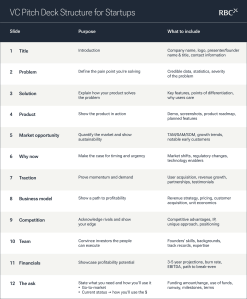
1. Title slide
You never get another chance to make a first impression. Your title slide sets the tone before you say a single word, so keep it clean and confident. Include your company logo, a one-line tagline that captures what you do, and your founders’ names with contact information. Make sure you let the slide breathe — avoid dense copy or the urge to overexplain your mission statement. The goal is to come across as polished, purposeful, and poised to be taken seriously.
2. The problem slide
Investors invest in solutions, but first, they need to understand the problem you’re addressing and why it exists. Clearly define the pain point you’re tackling with credible data and statistics to quantify its severity, and why it’s worth solving. Thorough market and customer research provides validation that the problem is real and represents genuine demand for your solution.
3. The solution slide
Now that you’ve established the problem, present your solution. This is the conceptual case for how your product or service addresses the issue and why it’s superior to what’s out there. Focus on your value proposition, the key features that matter most, your points of differentiation, and why users care. Keep it simple and avoid jargon — you’ll show the product itself in detail on slide 5.
4. The product slide
While slide 2 makes the conceptual case for your solution, this is where you show, not tell — investors want to see the actual product in action. Include screenshots, a short demo, or a walkthrough of the core user experience. Focus on the features that matter most, your points of differentiation, and what’s on the roadmap. The goal is to prove the product is real and works, not to inventory every feature.
5. The market opportunity slide
Astute investors want to know that what you’re building is sustainable and has the potential to be a category leader. Provide data-backed insights into market size, growth potential, and trends, and highlight notable early customers. Show that you’ve conducted thorough market research and there is product-market fit and demand for your solution.
When sizing your market, use the standard framework:
- TAM (Total Addressable Market): the full market demand for your solution.
- SAM (Serviceable Available Market): the segment you can actually reach with your business model and geography.
- SOM (Serviceable Obtainable Market): the realistic share you can capture in the near term, given competition and constraints.
6. The “why now” slide
Timing can make or break a pitch. Investors want to know not just that a problem exists, but that the conditions are right to solve it right now. This slide makes the case for urgency: what has shifted in the market, technology, regulation, or customer behaviour that makes this the moment to act.
“For me personally, you have to make a very compelling case explaining why now,” says Angela Tran, a San Francisco-based VC and General Partner of Version One, of which RBCx is a Limited Partner. “You have to really think about creating this urgency so that investors get FOMO so much that they don’t just want but need to invest.”
7. The traction slide
Demonstrate that your startup is gaining traction. Share key milestones (user acquisition numbers, revenue growth, strategic partnerships, or product launches) along with how that early traction can be accelerated. If applicable, include testimonials, press, and accolades.
This slide matters more than most founders realize: Make it unmissable.
8. The business model slide
Investors need to see a clear path to profitability. Outline your business model and revenue strategy — how you will acquire customers, generate revenue, and scale. Be specific about pricing, customer acquisition cost, and unit economics.
9. The competition slide
Acknowledge your competition and explain how your startup stacks up. Highlight your competitive advantages — IP, technology, or a unique approach that’s hard to replicate. Be honest about challenges and how you’ll overcome them. A competitive matrix or 2×2 positioning map is a common, effective format.
10. The team slide
Investors not only invest in ideas but in the people behind them. In the absence of significant revenue or a proven business model, it’s the team (their skills, backgrounds, relevant expertise, and track records) that VCs are ultimately backing. A strong, capable team can navigate challenges, pivot when necessary, and execute the plan.
11. The financials slide
Provide realistic financials that showcase your startup’s potential for profitability. Include three- to five-year financial projections, total revenue and expenses, burn rate, EBITDA, and a clear path to break-even and profitability.
The key is to be prepared to explain your assumptions and methodology, especially for an early-stage company that may not have much history or revenue. “One of the biggest mistakes that I see is not having the numbers to back up what you’re claiming,” says Kelly. “It’s great to be ambitious and optimistic, but when you’re going out to an investor, it has to be rooted in legitimate things that you can back up.”
For more on how investors evaluate the numbers, see our guides on venture capital and startup valuations.
12. The investment ask slide
Clearly state how much funding you’re seeking (a range is fine). Break down how you plan to use the funds (e.g., new hires, tech and product development), how long the financing will last, and what milestones you aim to achieve. Be transparent about terms (equity or convertible notes) and highlight notable existing investors. For a deeper dive on deal terms, see our primer on what a term sheet is.
“By the end of the presentation, it should be very clear what the problem is that you’re solving, why this team, and the investor should feel confident that this team is actually capable of tackling that problem,” says Kelly. “Nailing the pitch really comes down to your ability to tell the story of your business effectively, succinctly, and how you bring investors along the journey with you.”
How to design a pitch deck
A visually appealing pitch deck goes a long way to ensuring your story is delivered succinctly. Use clear, concise slides with compelling visuals, charts, and graphics to illustrate key points.
A useful benchmark for design discipline is Guy Kawasaki’s 10-20-30 rule: 10 slides, a 20-minute presentation, and a minimum 30-point font size. The rule forces clarity over clutter — large fonts mean less text per slide, which means you’re telling the story rather than reading it.
Kelly emphasizes not to get too hung up on aesthetics; you want investors to be impressed by you, not your slides. “There are a ton of resources and tools online that can ensure you’re compiling a pitch deck that is crisp, clean, and formatted well — this should be an absolute given,” she explains. “It’s not all about glitz and glamour. Make the content count and ensure you’re leading with your story and not your design.”
How to prepare for a pitch
Practice your presentation. Once you’ve created your pitch deck, practice your delivery relentlessly. Rehearse in front of trusted advisors, mentors, or peers. Focus on a confident, engaging, concise presentation that fits the allotted time.
“It’s okay to be nervous, but as a founder/CEO, you’re signing up to be in hard situations and in places that are really going to stretch you as a leader,” says Kelly. “But if you can’t thrive under that pressure, it might plant a seed of doubt in the investors. Come to the table with conviction so that they trust and believe in you.”
Handle questions effectively. Expect questions during and after your pitch — including ones meant to throw you off. Here are a few of the most common:
- Why is the problem you’re addressing important, and why now?
- How are you validating the market opportunity and your valuation?
- What evidence of market traction do you have — user growth, sales, partnerships?
- How will you use the money, and what happens if you run out?
Don’t be afraid to admit when you don’t have an answer, but assure investors you’ll follow up. Whatever you do, says Kelly, don’t fumble your way through it: “Think about the weak spots of your business and be prepared to have a non-BS answer for what you’re doing to solve for it. Just be ready.”
For a more comprehensive list, see our companion article on the 75 common questions venture capitalists ask before investing. And come prepared with your own questions — our guide on questions founders should ask potential VC investors can help.
Build relationships. Investor pitches are opportunities to build long-term relationships. Treat every meeting as a chance to connect. Even if a VC doesn’t invest immediately, a positive relationship can lead to future opportunities. “It’s never too early to build the right relationship with an investor,” says Kelly. “They may not feel it’s the right time to write you a cheque but it’s about building rapport, credibility, and bringing them along the journey.”
Learn from rejection. Don’t be discouraged by a no — view each rejection as a learning opportunity. Ask for feedback from investors who pass and use their insights to improve. “There are a thousand reasons why you might get a no from an investor, including some that are beyond your control,” explains Kelly. “As a founder, you need to go in with the mindset that a no right now does not mean no forever.”
Iterate and refine. The perfect startup investor pitch is a work in progress. As you gather feedback, iterate and refine. Continuously update your pitch deck and narrative to reflect your startup’s progress and evolving goals.
Dos and don’ts of a successful startup pitch
Do:
- Pre-pitch, do a brand audit; look at your company’s digital footprint (website, social media, founders’ LinkedIn) to ensure they’re up to date and professional.
- Send the deck as a PDF to potential investors in advance of your meeting.
- Use a consistent design including font size, colours, header styles, and layout throughout.
- Be prepared to do a product demo; showing it in action is your one chance to really captivate investors.
- Do a fast follow-up with interested investors after the pitch, providing additional information as needed.
Don’t:
- Overwhelm investors with excessive data or details; that information can be added to an appendix.
- Add too much text; your pitch deck is a visual aid that shouldn’t be read verbatim.
- Get bogged down with the nuts and bolts of your product; an early-stage business will likely iterate.
- Neglect timing; going over your allotted time can leave a negative impression.
- Forget to include a disclaimer in the footer of your pitch deck cover page: Confidential and Proprietary. [Name of your company]. All rights reserved.
Final thoughts on creating the perfect pitch
Crafting the perfect investor pitch is a challenging yet essential part of your entrepreneurial journey. Your pitch is not just about securing funding; it’s about conveying your vision, passion, and commitment. By understanding your audience, telling a captivating story, and addressing key business elements effectively, you can attract the right backers who believe in your startup’s potential. With practice, perseverance, and a compelling pitch deck, you can take your tech startup to new heights.
For more on the fundraising journey, see our guide to how to get startup funding in Canada.
Frequently asked questions
FAQs
RELATED TOPICS
Other articles you may be interested in





 © 2026 RBC All rights reserved.