
Key takeaways
- Mental resilience is just as integral to success as physical, according to Canadian Olympic sprinter Duan Asemota.
- Athletes and founders alike rely on the support of a trusted team to face tough challenges and achieve peak performance.
- Adopting a winning approach requires a clear perspective on losing and how one learns from setbacks.
For Canadian Olympian sprinter Duan Asemota, being a winner isn’t about chasing dreams of glory. It’s about training and dedication, both physical and mental — creating a pathway for success and working tirelessly to achieve it.
“Only then,” he says, “can you go out there and win.”
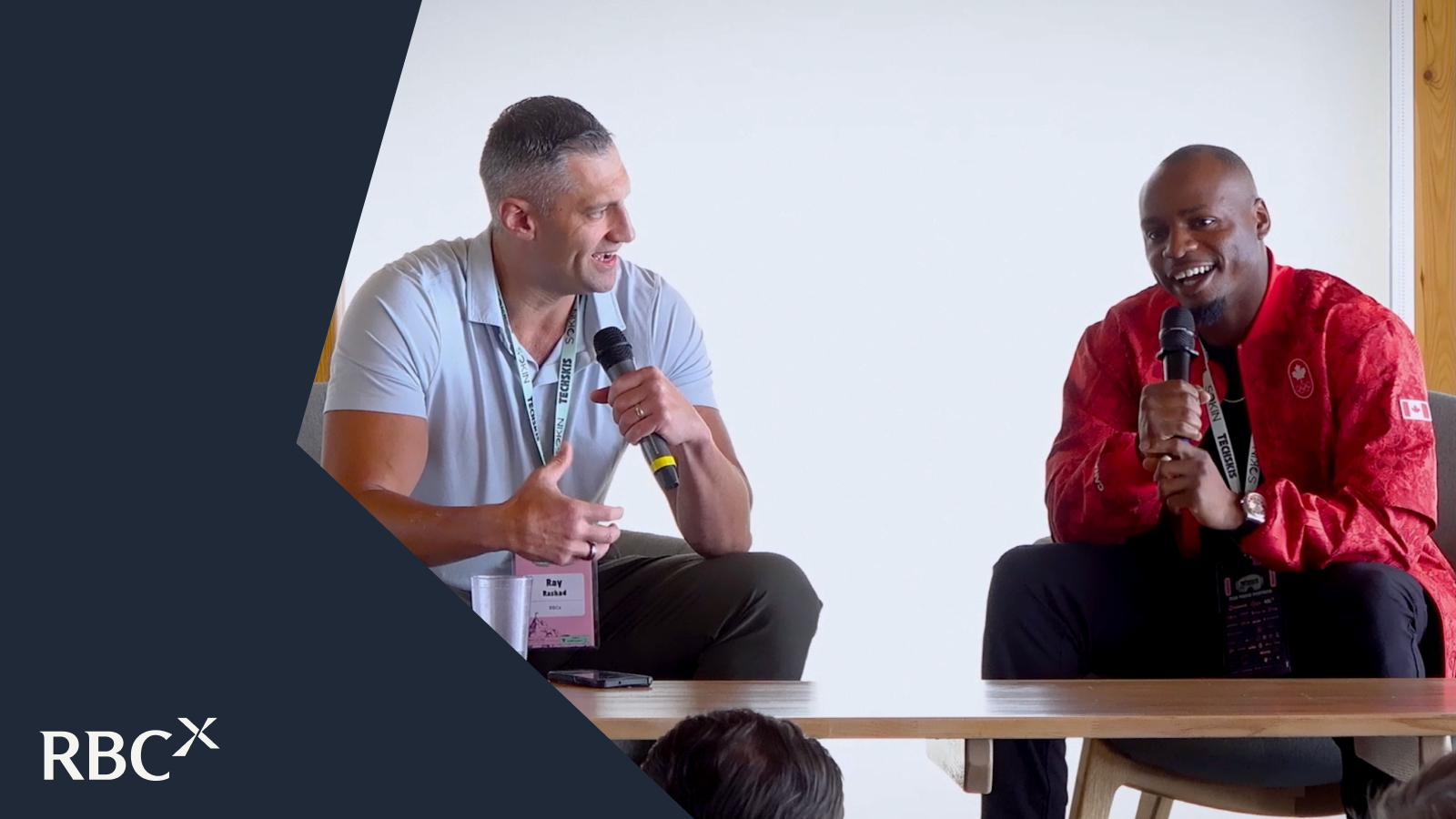
The journey to achieving that winning mindset was among the many topics of conversation at “Mental Resilience Under Pressure: Performing When Everything Is on the Line,” a fireside chat with Asemota as part of Techskis, the annual high-performance startup retreat held at Blue Mountain, Ontario.
Hosted by Ray Rashed, Managing Director at RBCx, before a roomful of founders, operators, and investors, the talk was an opportunity to hear how Asemota developed his strategies for performing at the highest level, even when pressures are high.
Putting in the hours: Overcoming setbacks and building resilience
Rashed is no stranger to sports himself, as a former football player who was drafted by the Hamilton Tiger-Cats and tested for the Canadian Olympic bobsled team. Given their common background in sports, the conversation between the two naturally began with talk of the athletic lifestyle.
Rashed described how his days of college athletics introduced him to early morning training. He still adheres to those routines today in the corporate environment, rising at 4:00 a.m. to work out, then seeing his kids off to school before beginning his work day.
Asemota also gets an early start every day, though, as he laughs, “I don’t really have a choice.” Maintaining the discipline high-level training demands unfortunately means enjoying less of a social life, a decision not everyone can relate to, even those who have supported him the most.
“I used to be in a group of friends who would always do stuff on Friday and Saturday nights. Then I really wanted to be good at track and field, but most people look at sports just as a recreational thing you do in high school or college. So when you’re doing it as a professional, you have to yield results for people to take you seriously.
“That includes my mom, who told me, ‘You know, it might be time to give this up.’”
Becoming a sprinter wasn’t something he’d foreseen. Born in Montreal and growing up in Ajax, Ontario, he was initially more interested in basketball. It was a high school track coach who first noted his natural ability as a sprinter and encouraged him to pursue track and field competitively. In those early days, however, he lacked the discipline that would later define his training.
“The first year, I didn’t take it that seriously because it came so easy to me,” he admits. “I was beating all these guys who’d been training for years, so I was really arrogant. Then you get to a point where you plateau and you realize, okay, I need to be putting in the work and the hours.”
His change in attitude was in some respects the product of frustration. “Honestly, I was really just getting tired of losing. I wanted to see what I could do if I really put my all into everything.”
That drive led him first to attend college in Kansas, then at Ohio State University, where he competed in NCAA Division I track along with pursuing his studies. Even still, that youthful arrogance persisted, almost derailing his progress.
“I got kicked off the team because I had a bad attitude. I thought I was the best person on the team. But that’s the stuff that you shake along the way. I wouldn’t have made it if I’d kept those habits up.”
With a revitalized attitude, he saw his growth begin to accelerate. He eventually earned a spot on Canada’s 4×100-metre relay team for the 2023 World Athletics Championships in Budapest. At the 2024 Summer Olympics in Paris, he competed in the men’s 100 metres and the 4×100-metre relay.
However, an untimely injury presented another setback, requiring him to look within and find the determination to persevere.
“Rehab is very lonely,” he recalls. “You have tough moments. You have to look yourself in the mirror and figure out who your identity is, who you really are.”
Those challenges led him to develop the habits and routines that eventually helped him win Canadian national titles in both individual and relay events. Now, he’s looking forward to competing in the 2028 Summer Games in Los Angeles.
The quick sprint and the long journey
Being an Olympian can involve years of training, all leading up to one crucial moment. While most of us will probably never compete on the world’s stage, we can all relate to that feeling of pressure as we rise to meet our own challenges. Founders, like athletes, need to be constantly reassessing their strategic goals and their ability to meet them, often in the face of daunting deadlines and weighty expectations.
For Asemota, much of gaining confidence comes down to preparation and unwavering dedication. “Don’t treat your schedule emotionally. Treat it as a matter of fact. And when your time’s up, your time’s up. Move to the next thing.”
While his career has been personally rewarding, he’s also had to face many hurdles. For many athletes, with hopes of Olympics glory come significant financial obstacles.
In a lot of ways, an athlete’s career is much like a founder’s: years of pursuing a dream through long hours and hard work, with many tests of faith in one’s self along the way. There can be times of great struggle and doubt before achieving goals like securing funding for a startup — or, in an athlete’s case, landing a sponsorship or another source of support.
A strategy for winning — and losing
Achieving optimal performance undoubtedly requires hard work, not only through intensive physical training, but also continually reflecting on one’s relationship to winning — and to losing.
“A lot of people look at it like you’re supposed to win all the time,” says Asemota, “but it doesn’t always work out like that. Sometimes the fall has to be hard, and that’s the best way you learn to not fall the same way you did last time.
“I look at where I went wrong, the whole process leading into it. How my mindset was, how my body was feeling, what was my sleep like, what my energy level was like. You have to break things down in order to get to that. Because honestly, every time I race, I think I’m at 100%. Not until things go the way they do, do I realize, okay, maybe there could have been 5% to 10% here, and I can only get that by going back and looking.
“Along the way, you get things wrong. You make mistakes. But that’s really just collecting data. Just don’t let the data discourage you. Look at it objectively. You always have to be prepared to lose, and to know that losing isn’t the end of the world.”
That paradoxical nature of progress — that only by being a good loser does one learn how to win — is one of the elements that’s defined Asemota’s ascent. But as every successful founder or entrepreneur understands, chasing one’s dreams doesn’t have to mean going it alone.
“If you feel you have people you can count on and who support you — your parents, your friends, your family — it makes going into competition a lot easier,” says Asemota. “You know you’re going to be okay after this.
“Deal with the outcome that it could possibly not work out. Once you let that go, go into competition and just be the best version of yourself.”
Asemota’s hopes for medal victory look bright, the result of years of cultivating inner resilience, both physical and mental. As Rashed wrapped up the chat, the room joined together in sending this Olympian off with a rousing cheer of “Go Canada Go!”
RBCx offers support to startups in all stages of growth, backing some of Canada’s most daring tech companies and idea generators. We turn our experience, networks, and capital into your competitive advantage to help you scale and make a meaningful impact on the world.
Speak with an RBCx Advisor to learn more about how we can help your business grow.
Check out the full conversation.
As the longest-standing corporate partner of Team Canada, RBC has proudly championed the Olympic movement in Canada since 1947. RBC supports amateur athletes at every stage of their career — from up-and-coming next-generation talent to multi-time Olympic medallists — through initiatives like RBC Training Ground and the RBC Olympians program.
RELATED TOPICS
Other articles you may be interested in





 © 2026 RBC All rights reserved.