
Key takeaways
- New RBCx data shows far fewer companies are raising heading into H2 2026.
- Capital is concentrating in larger funds.
- Emerging managers are facing an estimated 36% funding shortfall, limiting an important source of early-stage risk capital.
Fewer founders are raising. Here’s what’s happening.
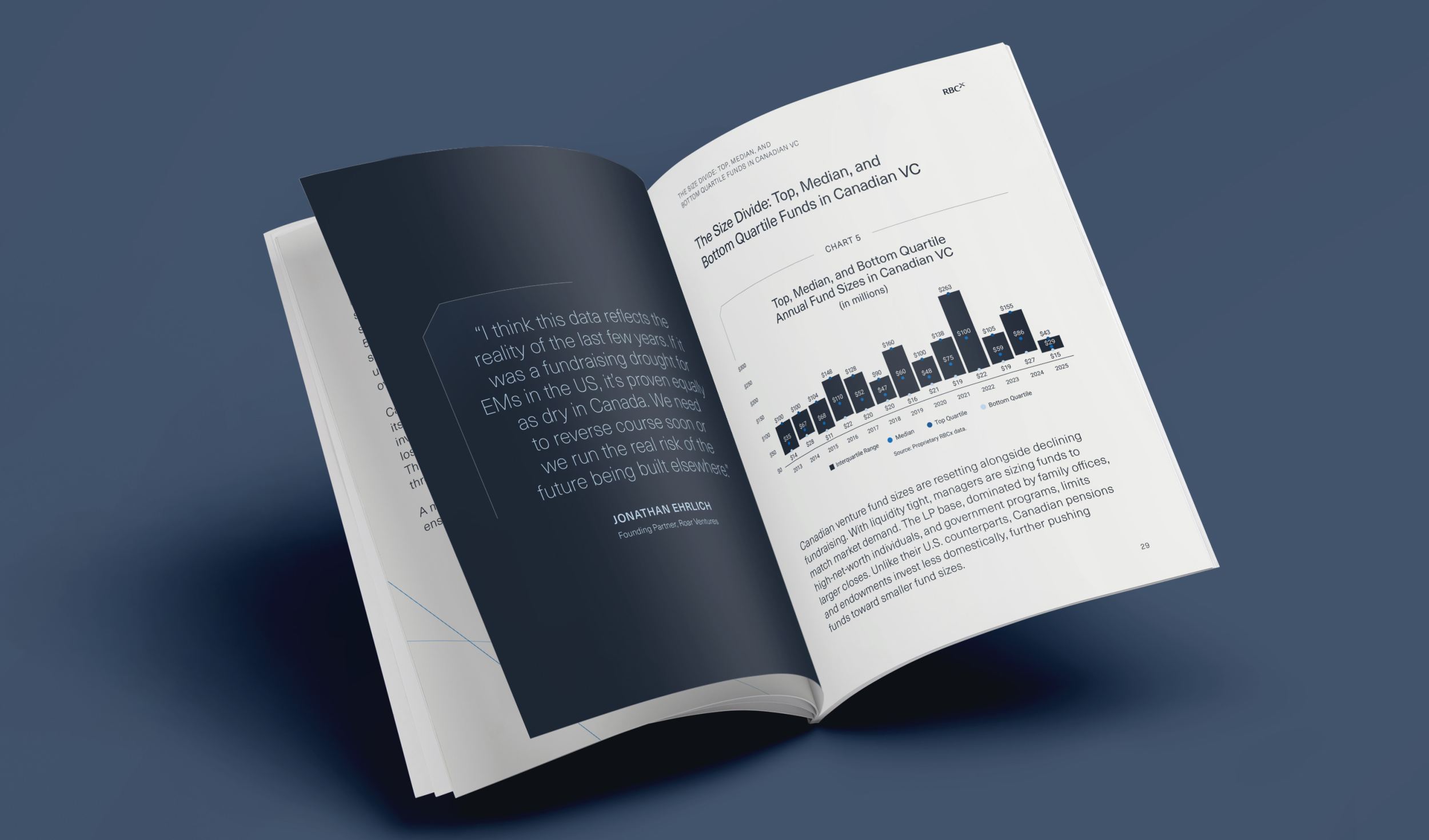
Earlier this year, we published our 2025 report on Canadian VC Fundraising, Capital Under Pressure, which identified growing capital concentration and a meaningful funding gap for emerging managers. RBCx’s proprietary datasets are starting to allow us to see what those structural shifts look like at the company level, and the picture confirms what many founders are telling us.
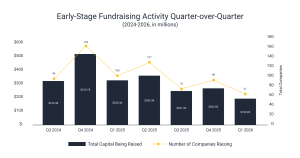
RBCx’s Early Stage Banking team works with more than 1,200 Pre-Seed and Seed stage companies headquartered in Canada each year, representing over 2,100 conversations across the dataset period. Among the 700 companies actively raising at the time, we saw a peak in January 2025 — 162 companies raising a combined ~$510.7 million. By March 2026, just 61 companies were actively raising, with total capital sought down to roughly $189.8 million.
The average raise per company held steady at around $3 million from September 2024 to March 2026, yet our data shows less are actively raising in Canada. The question is, why? Various structural forces are at work and each one pressures early-stage founders in different ways.
The capital base has narrowed
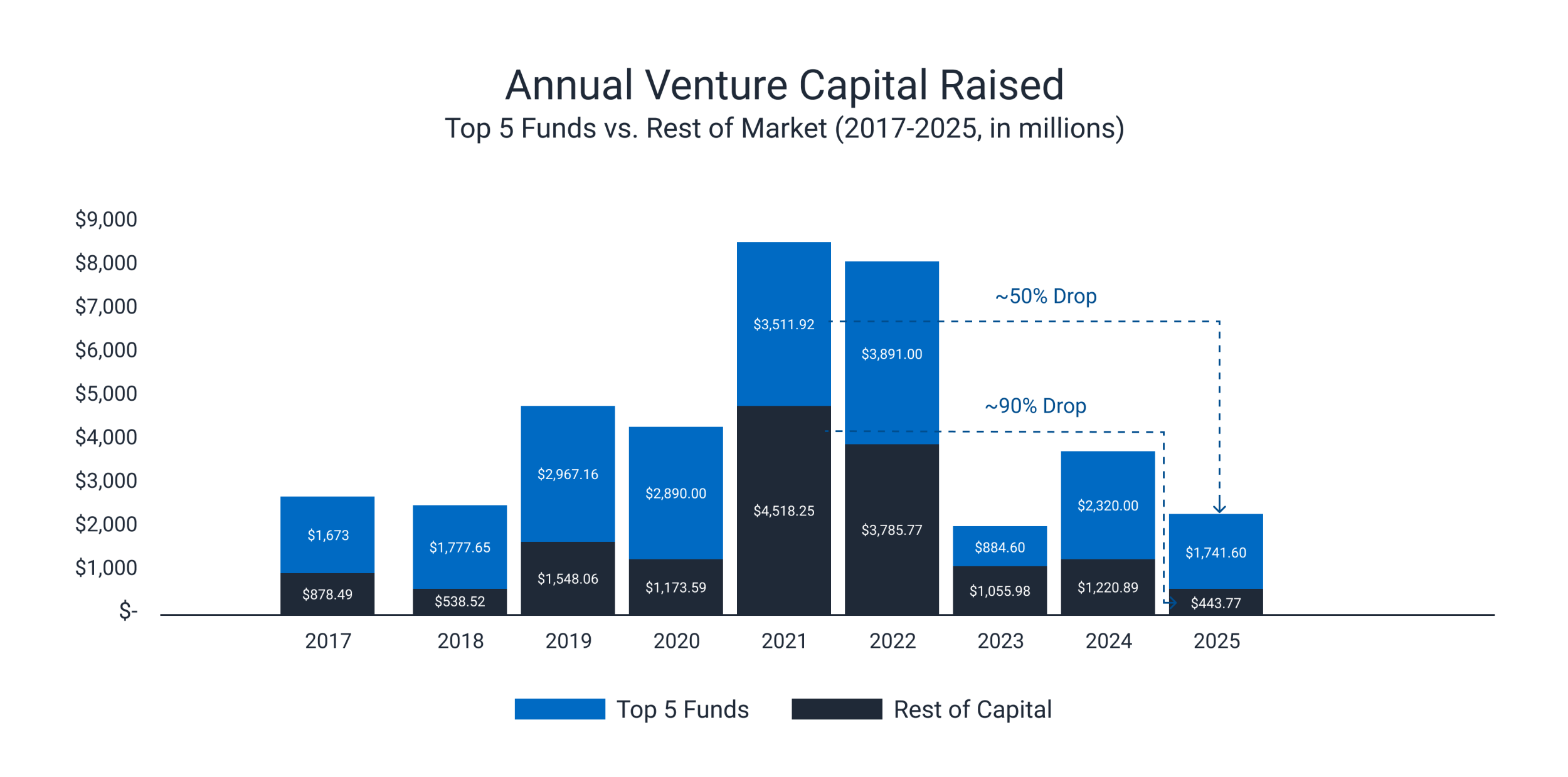
The headline story in Canadian VC is concentration. In 2023, the top five funds captured 46% of total capital raised. By 2025, that share hit 80%, with Radical Ventures Fund IV, Portag3 Ventures Fund IV, Yaletown Growth Fund III, Version One Ventures Fund V, and Garage Capital Fund V representing most of the capital in market.
In dollar terms, the top five funds raised roughly half of what they did at the 2021 peak. All other funds combined dropped from $4.5 billion to $444 million over the same period — close to a 90% drop.
Emerging managers are underfunded
Emerging managers are generally most willing to write early-stage cheques. LPs are still dealing with weak liquidity as capital has continued to be called, while distributions remain limited and less funds are flowing to emerging managers. Until meaningful exits return cash to the market, many LPs will keep prioritizing experienced managers over newer ones.
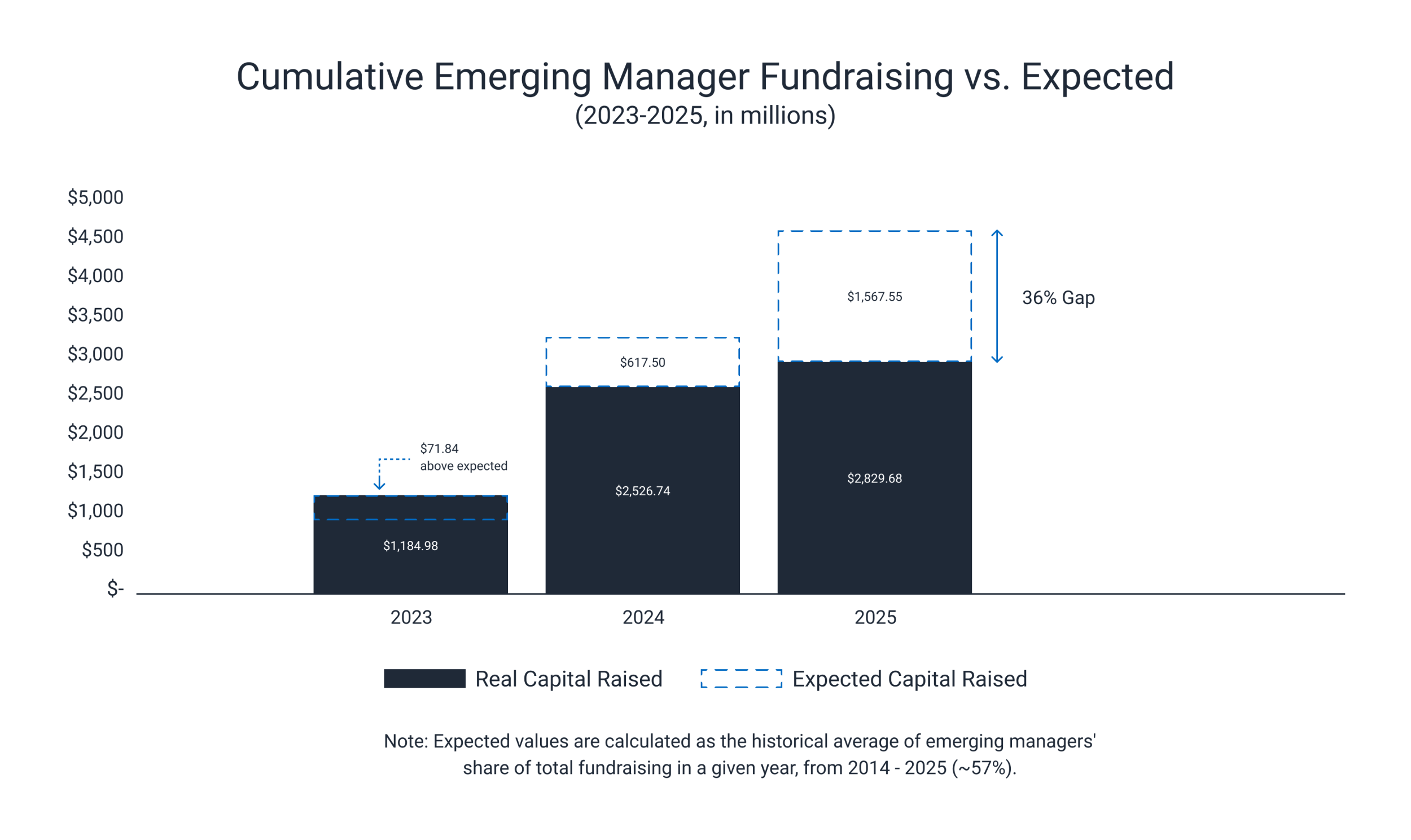
Based on historical averages, emerging managers would have been expected to raise approximately $4.3 billion cumulatively over the past three years. They raised roughly $2.8 billion, a 36% shortfall.
Emerging managers who raised their first fund during the 2020–2021 peak are now facing a much harder successor fundraising market. If fewer of them graduate into their next funds, Canada loses the early-stage bench most willing to back first-time founders and non-consensus ideas — and that capacity can’t be quickly rebuilt.
“Emerging managers are the engine of early-stage innovation in Canada. They’re willing to take on the riskier bets by backing first-time founders solving problems the market hasn’t fully recognized yet,” said Matt Roberts, Managing Director, Venture Coverage at RBCx. “When emerging managers are underfunded, it’s not just a financing gap — it’s an innovation gap.”
The growth-stage drought is felt all the way down
Early-stage companies don’t just need capital for the round in front of them, they need confidence that capital will be available at the next stage. When the Series B and growth market is thin, it shapes how founders plan, how early investors reserve capital, and how much risk the ecosystem can absorb. The CVCA reported the lowest quarterly deal count since 2017 in Q1 2026 — just 104 deals totalling $936M — with only one growth-stage deal completed.
It’s worth putting the Q1 early-stage share in context: pre-seed through Series B rounds represented nearly 70% of total Q1 investment, a tilt toward earlier stages the CVCA noted “hasn’t really happened before.” That sounds encouraging, but it reflects weakness above as much as strength below. Dollar share and market breadth are different things, and RBCx’s company-level data makes that distinction clear.
“Venture capital plays an important role at the early stage, especially for businesses in cleantech and life science with heavy upfront costs in R&D. Without funds available, the innovation pipeline narrows,” said Tony Barkett, Head of Banking at RBCx.
What needs to change
Companies are still getting funded. The harder question is whether capital can reach a broader set of Pre-Seed and Seed founders, and not just the ones who already have the right relationships in the right rooms.
Rebuilding that breadth starts with more LP capital flowing to emerging managers and a stronger growth-stage market. Early-stage investors plan around what the next round will look like, and as outlined above, a thin growth-stage market raises the bar at the point of entry even when early-stage capital exists. Strengthening the later stages of the funding journey gives investors at every stage more room to take risk earlier.
That’s what makes RBC’s plan to invest up to $1 billion in Canadian growth-stage companies meaningful for the entire innovation economy. By helping more homegrown companies scale rather than seeking foreign capital to grow, it strengthens the entire funding journey. “I believe Canada can become the world’s premier destination for long-term investment — but only if it moves with purpose, urgency and speed in a race for capital that’s never been more intense,” said RBC CEO Dave McKay.
At RBCx, we remain committed to the founders building through this environment, with tailored financial products, non-dilutive funding, and direct connections to VCs at every stage. The proprietary RBCx data sets introduced in this update are part of that work, and we’ll keep developing them as we build a clearer picture of what Canada’s startup ecosystem needs to move forward.
*About the data: These findings are based on RBCx’s proprietary data which combines an analysis of historical Canadian venture capital fundraising patterns over a multi-year period as well as primary research conducted on 700+ pre-seed and seed-stage Canadian companies between Q3 2024 to Q1 2026. Expected values are calculated as the historical average of emerging managers’ share of total fundraising each year according to public and privately disclosed data sources dating back to 2014. All figures are approximate and reflect data available up to H1 2026. This data is intended for informational purposes only and should not be construed as investment advice.
RELATED TOPICS
Other articles you may be interested in




 © 2026 RBC All rights reserved.